

Performance
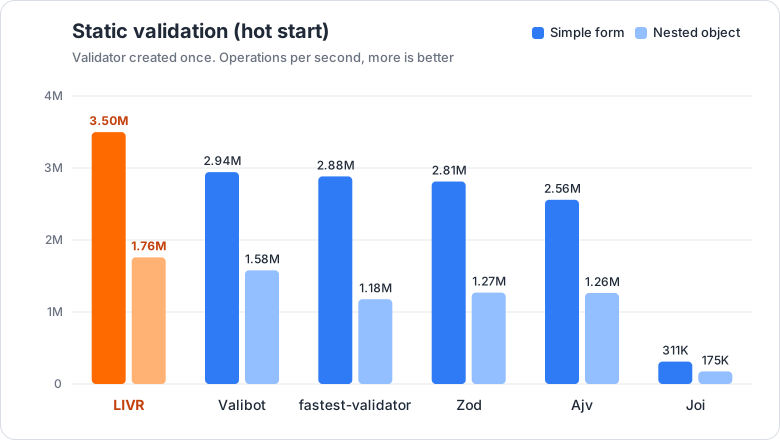
LIVR is the fastest of the popular JavaScript validators in both benchmarks: with rules fixed in code, where a validator is created once and reused, and with rules built at runtime, where every call needs a new validator. It gets there without generating code, so its schemas stay plain data that is safe to load from anywhere.
Speed in both modes is the priority → schemas are compiled into closures once, never into JavaScript source → no extra speed from code generation, and LIVR is still the fastest
Rules fixed in code
The usual case: a schema in your code, one validator for the lifetime of the process (static validation, hot start).
Rules built at runtime
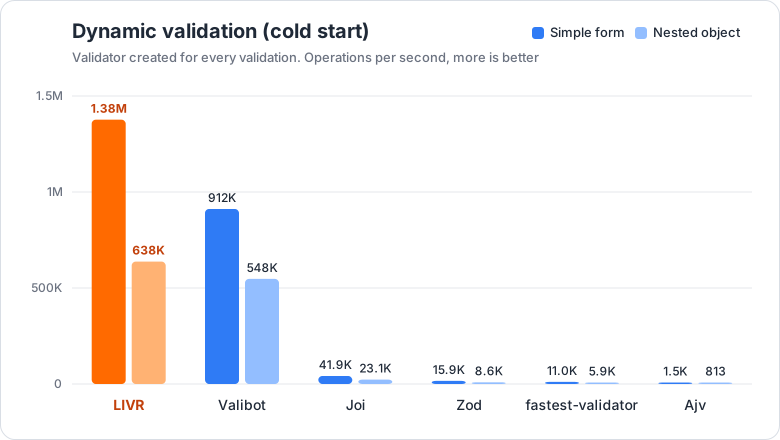
Rules are often not known when the process starts: they live in a database and change without a deploy, differ per tenant or per customer plan, come from a form builder or a CMS, or are put together from the data of a request. Then every call needs a new validator (dynamic validation, cold start):
// The rules of a form are edited by the customer in an admin panel
app.post('/forms/:formId', async (req, res) => {
  const rules = await db.getFormRules(req.params.formId);
  const validator = new LIVR.Validator(rules); // a new validator for every request

  const data = validator.validate(req.body);
  if (!data) return res.status(422).json(validator.getErrors());
  // ...
});
A cache of validators helps only when the rules repeat, and it has to be invalidated when they change. With LIVR, creating a validator is so cheap that you can skip the cache. Validators that generate code pay for generating and compiling JavaScript again for every new schema, and here the gap grows to hundreds of times:
All results
LIVR in operations per second, the others as how many times they are slower than LIVR:
| Validator | Created once | Created per call | ||
|---|---|---|---|---|
| Simple form | Nested object | Simple form | Nested object | |
| LIVR 2.11.0 | 3.50M ops/s | 1.76M ops/s | 1.38M ops/s | 638K ops/s |
| Valibot 1.5.0 | 1.2× slower | 1.1× slower | 1.5× slower | 1.2× slower |
| Joi 18.3.0 | 11× slower | 10× slower | 33× slower | 28× slower |
| Zod 4.6.7 | 1.2× slower | 1.4× slower | 86× slower | 74× slower |
| fastest-validator 1.19.1 | 1.2× slower | 1.5× slower | 126× slower | 108× slower |
| Ajv 8.20.0 | 1.4× slower | 1.4× slower | 949× slower | 784× slower |
How LIVR gets its speed
The schema is compiled once. On the first validation, or when you call prepare(), every rule of the schema is turned into a small function: the rule factory receives its arguments, does the expensive work once (like builds its regular expression, one_of converts the allowed values to strings, or to a map for long lists) and returns a closure that only checks a value. Validation is a loop over these closures. Nothing is parsed or looked up again.
Creating a validator is cheap. Building closures from a JSON structure costs far less than generating JavaScript source and compiling it with new Function(), which is what fastest-validator and Ajv do. That is why they are 100–130 and 780–950 times slower than LIVR when a validator is created per call.
The hot path allocates little. All rules share one output array, the errors object is created only when there are errors, and metarules like list_of and or validate their items through getFieldRule(), without building result and errors objects for every item.
The async validator stays sync until it has to. AsyncValidator runs rules synchronously and waits only for a rule that returns a promise, so async validation of sync rules costs little more than sync validation.
Fast enough for anything
3.5 million validations per second of a five-field form is about 300 billion validations a day on one CPU core. In a real service, the network, the database and the business logic take far longer than validation. So the point of the numbers is not that you need them, but that choosing data over code, and safety over code generation, costs nothing in speed.
How the numbers were measured
The benchmark lives in its own repository, validators-benchmarks, with the code of every scenario. The charts on this site are its latest published results.
- Simple: a form of five fields: required strings, an email, a positive integer, an enum and a minimum length
- Nested: an object with two levels of nested objects and a list of strings
- The schemas of all validators are equivalent: the benchmark checks that all of them accept and reject the same data, and unknown fields are removed from the output
- Every validation gets a new input object, because fastest-validator and Ajv change their input
- Every result is an average of repeated runs
Absolute numbers depend on the hardware, so compare the ratios. To check them on your machine:
git clone https://github.com/koorchik/validators-benchmarks
cd validators-benchmarks
npm install
npm run bench